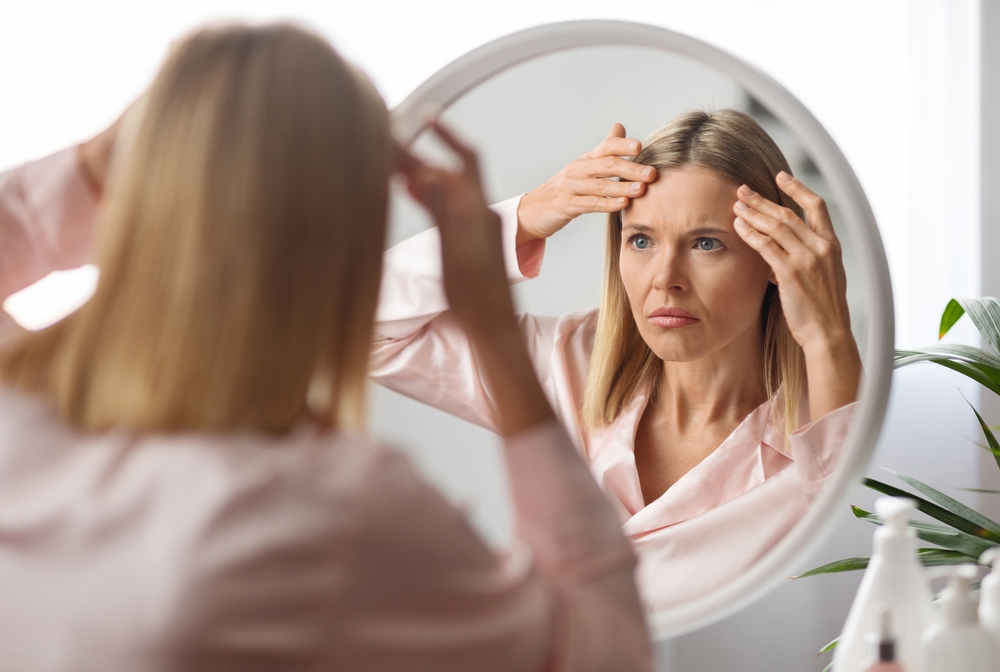
In perimenopause my skin stopped making sense. First the acne came back, the kind I had not seen since I was a teenager, along my jaw and chin. Then, a few weeks later, my face was so dry it felt tight after washing. Then it was oily again. Dry, oily, breaking out, dull, repeat. It was a rollercoaster, and no product fixed it, because the problem was not my skincare. It was my hormones and my sleep, and until I could see those two things clearly, I was treating the symptom and missing the cause.
The short answer. Perimenopause skin changes happen because estrogen does not decline in a straight line. It swings, sometimes month to month, and each swing changes how much oil your skin makes, how much water it holds, and how fast it repairs. At the same time, broken sleep (often from night sweats) weakens the skin barrier directly. That is why skin in your 40s can be oily, dry, and breaking out all in the same season. The fix starts with seeing the pattern, not buying another serum.
Why does perimenopause make skin so unpredictable?
Your skin is a hormone organ. It carries receptors for estrogen, androgens (like testosterone), and cortisol, which means it responds to every shift in those hormones. In your 20s and 30s, estrogen is relatively steady and relatively high, and it quietly does a lot of work: it keeps oil production moderate, holds water in the skin, supports collagen, and speeds up repair.
Perimenopause is not the loss of estrogen. It is the instability of estrogen. Levels can spike higher than they were in your 30s one month and crash the next. A 2024 review in Cosmetics explains the result: low estrogen markedly reduces sebum (oil) production, while the perimenopausal shift toward relatively more androgen activity causes sebum to vary. In plain language, your oil glands are getting mixed signals. One week they underproduce and you feel dry and tight. The next week they overproduce and you break out. That was my rollercoaster, and it is biology, not bad luck.
Why is acne back in my 40s?
Because the ratio has changed. Estrogen falls, but the ovaries and adrenal glands keep producing androgens, so even with normal testosterone levels your skin experiences a relative androgen excess. Androgens drive oil production and inflammation in the hair follicle, which is the recipe for the deep, slow-healing breakouts along the jaw and chin that so many midlife women describe.
You are not imagining that this is common. A 2024 review in the International Journal of Women’s Health reports a French survey of 3,394 women that found acne in 41% of adult women, and 41% of those had never had acne as teenagers. The same review notes that most women with adult acne have normal androgen blood levels, which is why a “normal” lab result does not rule out a hormonal cause, and why stress made acne worse for about half of the women surveyed. A 2025 clinician’s review in EMJ Dermatology puts perimenopausal acne at roughly one in four women.
Why is my skin suddenly dry, thin, or itchy?
This is the other side of the same coin. Estrogen tells fibroblasts, the cells that build your skin’s structure, to make collagen, elastin, and the water-binding molecules (hyaluronic acid and other glycosaminoglycans) that keep skin plump. When estrogen drops, that production slows fast. The Cosmetics review cites the classic finding that women lose about 30% of their skin collagen in the first five years after menopause, then roughly 2% a year after that, with skin thickness falling about 1.1% a year. The EMJ Dermatology review adds that this loss tracks how long you have been low in estrogen, not your age.
Less collagen and fewer water-binding molecules mean thinner, drier skin that is slower to repair and quicker to itch. In the Cosmetics authors’ own survey, 53% of women reported dryness and 35% reported new hyperpigmentation. And in a UK menopause clinic survey summarized by EMJ Dermatology, every single woman reported at least one skin symptom, 46% said an existing skin condition had worsened, and 48% had never mentioned their skin to a clinician. Nearly half of us are sitting on this quietly. I did, for far too long.
What does sleep have to do with my skin?
More than most skincare advice admits. Perimenopause is one of the most common causes of broken sleep in women: night sweats, 3 a.m. wake-ups, and the racing mind that follows. In the Cosmetics survey, 53% of women reported insomnia, the same proportion that reported dry skin, and that is not a coincidence.
A 2022 study in Sleep Medicine took 24 healthy women aged 30 to 55 and restricted them to three hours of sleep for just two nights. Skin hydration fell, transepidermal water loss (the measure of a leaky skin barrier) rose, skin pH climbed, facial brightness dropped, dark circles darkened, and a marker of oxidative stress in the skin jumped, all with very strong statistical significance. Two nights. Now imagine three years of night sweats.
The mechanism runs through cortisol. Poor sleep and stress raise cortisol, and a 2023 review in the International Journal of Dermatology details how stress hormones impair the skin barrier: slower recovery, fewer protective lipids, more inflammation. Cortisol also feeds the acne side of the story, since stress worsened breakouts for roughly half of the women in the acne survey above. So the loop looks like this: hormone swings disrupt sleep, poor sleep raises cortisol and weakens the barrier, the weakened barrier shows up as dryness, dullness, and breakouts, and the stress of dealing with your skin disrupts sleep a little more. Breaking that loop starts with knowing which night and which week the trouble began.
How do I know whether it is hormones, sleep, or my skincare?
You look for the pattern, and the pattern is almost impossible to see without data. When my skin was at its worst, I could not have told you whether the breakout followed a bad week of sleep, a cycle that came early, or the new moisturizer. I was guessing. Once I started tracking, the picture changed. The dry spells lined up with the weeks my cycle went long and my hot flashes spiked. The breakouts followed the stretches where I slept under six hours for four nights running.
This is where Harmoni comes in. Harmoni tracks dry and itchy skin as one of her 27 symptoms, so you can log the skin itself, by voice, the moment you notice it. More importantly, she tracks the two things most likely driving it: your sleep, pulled directly from Apple Health or Fitbit, including sleep stages, heart rate variability, and 30 days of history; and the rest of her 27 perimenopause and menopause symptoms, including hot flashes, night sweats, cycle changes, mood, anxiety, and energy. You can tell Harmoni how you are feeling by voice, with no buttons to press, and Harmoni interprets the trend in plain language, so a week of itchy, dry skin shows up next to the week of broken sleep that preceded it.
Then you can do what I did last week. Harmoni produces a 30-, 60-, or 90-day trend report with one interpretation written for you and one written for your clinician. Bring it to your dermatologist or your menopause provider and say: here is when my sleep broke, here is when my hot flashes peaked, and here is when my skin fell apart. That conversation goes very differently from “my skin has been weird lately.”
What actually helps midlife skin?
Three layers, in this order.
Protect the barrier you have. Switch to a gentle, non-foaming cleanser, a ceramide-rich moisturizer, and daily broad-spectrum SPF 30 or higher. Stop stripping. The instinct when acne returns is to treat it like you did at 16, with harsh acids and drying spot treatments, but the International Journal of Women’s Health review specifically cautions that benzoyl peroxide and similar products need care in older women because of dryness and irritation. Thin, dry, perimenopausal skin cannot take what teenage skin could.
Treat the sleep. This is the lever most women skip. Cooler bedroom, consistent wake time, no alcohol within three hours of bed, and a conversation with your clinician about night sweats if they are what is waking you. If you fix nothing else, fixing sleep changes the barrier within days, as the Sleep Medicine study shows in reverse.
Address the hormones with a clinician. If hot flashes, night sweats, cycle changes, and mood shifts are travelling with your skin changes, that is a hormone conversation, not a skincare conversation. A 2023 meta-analysis of 15 studies and 1,589 women found menopausal hormone therapy increases skin collagen and elasticity, though hormone therapy is prescribed for symptoms, not for skin, and it is a decision to make with your provider. For women who want to work on the skin directly, prescription creams built on topical estriol and the copper peptide GHK-Cu are now part of the menopause-skin conversation; our sister practice, Amsara Health, has written a plain-language explainer on what GHK-Cu is and what the research shows.
When should I see someone about my skin?
Sooner than you think. If your skin has changed in a way that bothers you, that is reason enough; remember that nearly half of women in the clinic survey never raised it. See a clinician promptly if you have a new or changing mole, a rash that does not resolve, acne that is scarring, or itching that keeps you up at night. And if your skin changes arrived alongside cycle changes, hot flashes, or sleep disruption, bring all of it to the same appointment. They are one story.
Frequently asked questions
Why does perimenopause cause acne?
Estrogen falls while androgens stay relatively steady, creating a relative androgen excess that increases oil production and follicle inflammation, even when blood androgen levels test normal. Stress and poor sleep raise cortisol, which makes it worse. A 2024 review found acne in 41% of adult women surveyed, and 41% of them had never had it as teenagers.
Why is my skin oily and dry at the same time in perimenopause?
Because estrogen is swinging rather than steadily declining. Low estrogen reduces oil production, while the shift toward androgen activity makes oil production vary, so skin can be dry one week and oily or breaking out the next. Tracking your cycle, sleep, and symptoms usually reveals the pattern.
Does lack of sleep really affect skin?
Yes, measurably. In a 2022 study, two nights of three hours of sleep lowered skin hydration, increased water loss through the skin, raised skin pH, dulled facial brightness, and darkened under-eye circles in women aged 30 to 55. Poor sleep raises cortisol, which weakens the skin barrier.
How much collagen do you lose in menopause?
About 30% in the first five years after menopause, then roughly 2% a year, with skin thickness declining about 1.1% a year. The loss tracks the duration of low estrogen more than chronological age.
Can a menopause tracking app help with skin changes?
Yes. Harmoni tracks dry and itchy skin as one of its 27 symptoms, alongside sleep (from Apple Health or Fitbit), hot flashes, night sweats, cycle changes, and mood, which are the main drivers of midlife skin changes. Its 30- to 90-day trend report lets you and your clinician see whether skin flare-ups follow poor sleep or hormone swings. Harmoni is free to download.
Does HRT improve skin?
A 2023 meta-analysis of 15 studies and 1,589 women found menopausal hormone therapy increases skin collagen and elasticity. HRT is prescribed for menopause symptoms rather than for skin, so this is a conversation to have with your clinician about your whole picture.
Sources: Bravo et al., Cosmetics, 2024 · Dias da Rocha et al., Int J Womens Health, 2024 · DeGiovanni, EMJ Dermatology, 2025 · Léger et al., Sleep Medicine, 2022 · Lyu et al., Int J Dermatology, 2023 · Pivazyan et al., meta-analysis, 2023. This article is for education and is not medical advice. Talk with your clinician about changes to your skin, sleep, or hormones.
Ready to find your pattern? Harmoni® by thePause® is now free to download. Connect Apple Health or Fitbit, log dry or itchy skin by voice the day you notice it, and in 30 days you will be able to see whether your skin follows your sleep, your cycle, or both.