
Perimenopause and menopause represent one of the most biologically complex and consequential health transitions in a woman’s life. Yet despite affecting every woman who lives long enough, this transition remains among the least personalized areas of modern healthcare.
According to large-scale reviews published in the Journal of Clinical Medicine 80 to 90 percent of women experience symptoms during the menopausal transition. Sleep disruption alone affects 16 to 47 percent of women during perimenopause, increasing to 35 to 60 percent during menopause, with many reporting difficulty falling asleep, frequent awakenings, and nonrestorative sleep. Cognitive symptoms are also widespread. Self-reported data suggests that 50 to 75 percent of women experience cognitive complaints, including memory lapses, difficulty concentrating, and mental fatigue. These symptoms often occur alongside changes in energy levels, stress response, mood regulation, and weight distribution, yet many women receive limited explanation, validation, or individualized support under current clinical models.
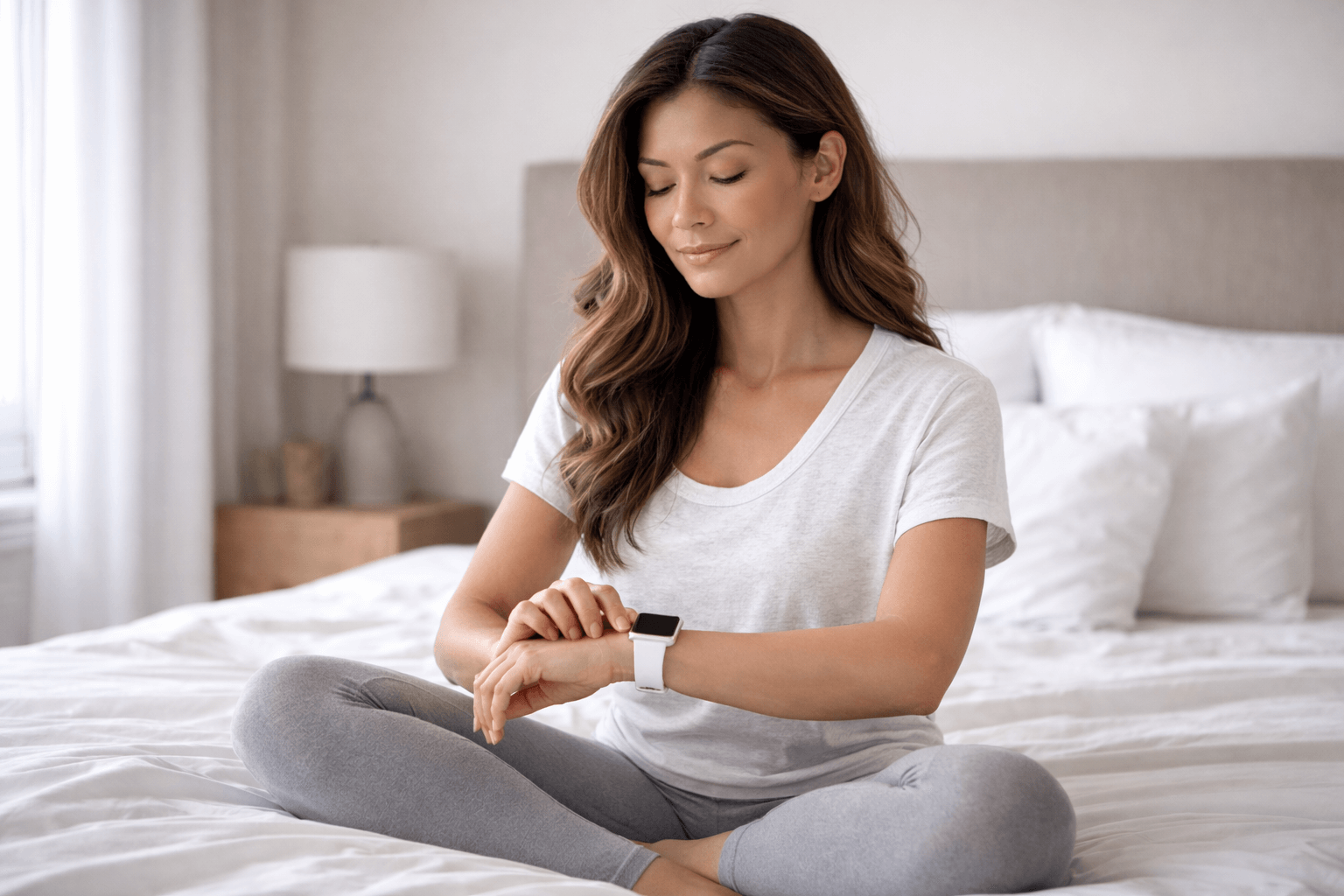
This disconnect between lived experience and available tools is where wearable technology, when used thoughtfully and in context, can help close the gap. Wearables give women access to objective physiological data that can be reviewed alongside how they actually feel, not instead of it.
Wearable Adoption and Women in Midlife
Wearable devices have become mainstream in the United States. According to research published in the Journal of Medical Internet Research 44.5 percent of U.S. adults report owning at least one wearable device, based on survey data from nearly 24,000 respondents. Women were slightly more likely than men to own a wearable, with an adjusted odds ratio of 1.10 after controlling for age, income, and education. Adoption was highest among adults aged 30 to 64, the same age range most affected by perimenopause and menopause.
Additional national data from the National Heart, Lung, and Blood Institute shows that approximately 30 percent of U.S. adults actively use wearable health tracking devices, including smartwatches and fitness trackers. This level of adoption suggests that wearable technology is already shaping how women think about sleep, activity, recovery, and stress during midlife.
The Historical Limitations of Wearables for Women’s Health
Most consumer wearables rely on photoplethysmography, or PPG, a light-based technology used to estimate heart rate, heart rate variability, and sleep stages. According to research published in npj Digital Medicine PPG accuracy can vary based on physiological factors such as skin tone, tissue composition, and movement. Historically, many wearable validation studies included limited representation of women, older adults, and people with darker skin tones, which can affect both measurement accuracy and algorithmic interpretation.
At the same time, much of medical research and digital health development has relied on male-centered baselines. This long-recognized Gender data gap is widely discussed in health technology literature and means that physiological norms embedded into algorithms may not fully reflect hormonal variability, autonomic nervous system changes, or metabolic shifts that occur during perimenopause and menopause.
Why Women Must Verify Their Own Wearable Data
Many women report seeing high sleep scores from wearables while waking up feeling exhausted or foggy. This disconnect is supported by sleep research.
According to reviews published in Sleep Medicine Reviews subjective sleep quality often diverges from objective sleep duration, particularly in midlife women. Wearable sleep scores typically prioritize duration, movement, and heart rate patterns, but they may not fully capture hormonal disruption, night sweats, stress-related arousals, inflammation, or neurological recovery.
Wearables are most powerful when used to verify trends over time, not judge single nights or isolated scores.
What Wearables Do Well: Pattern Recognition Over Time
Wearables excel at continuous data collection. According to digital health research published in Sensors longitudinal biometric tracking is significantly more useful than isolated measurements for identifying meaningful physiological changes.
For women in perimenopause and menopause, this includes tracking recovery capacity, correlating sleep disruption with symptom flares, observing responses to lifestyle changes, and detecting early signals that precede symptom escalation.
Testing Multiple Wearables to Support Women’s Health
At thePause®, we are actively testing multiple wearable platforms, including Oura Ring, Apple Watch, Garmin, Fitbit, and WHOOP, to better understand how different devices capture and interpret data relevant to women in midlife.
Comparative reviews in digital health literature note that no single wearable captures every aspect of health perfectly, reinforcing the importance of interpretation and context rather than reliance on a single score or device.
WHOOP as a Recovery and Physiology Case Study
WHOOP provides continuous tracking of heart rate, heart rate variability, sleep, respiratory rate, and strain. According to a 2024 systematic review published on medRxiv WHOOP demonstrates acceptable accuracy for heart rate and two-state sleep detection, supporting its use for monitoring physiological trends.
A validation study conducted by Central Queensland University and summarized by WHOOP found 99.7 percent accuracy for heart rate and 99 percent accuracy for heart rate variability compared to reference standards.
Large-scale observational research involving nearly 12,000 WHOOP users, published in Sensors found that consistent wearable use over 12 weeks was associated with lower resting heart rate, higher heart rate variability, improved sleep consistency, and increased physical activity.
The Vision: Integrating Wearable Data With User-Reported Experience
Wearable data alone is not enough. Numbers without context can mislead as easily as they can inform.
At thePause®, our vision is to integrate wearable-derived physiological data with user-reported symptoms, behaviors, mood, and lived experience. This approach recognizes that women are the experts in their own bodies and that technology should support that expertise rather than override it.
By combining objective data with subjective reporting, women can validate trends, identify symptom triggers, navigate perimenopause and menopause with customized insights, and engage in more informed conversations with healthcare providers.
Conclusion
Wearable technology is not a diagnosis, a cure, or a replacement for clinical care. It is a tool. For women in perimenopause and menopause, it can be a powerful one when used thoughtfully, interpreted with context, and combined with lived experience.
By integrating wearable data with self-reported symptoms, women can move beyond generic scores and toward personalized, data-informed navigation of midlife health. At thePause®, we believe this approach is essential to closing long-standing gaps in women’s health and giving women clarity, confidence, and agency during one of the most important transitions of their lives. We encourage you to download our app and use it to take control of your midlife journey.
Written by: Susan Sly – Founder & CEO of The Pause Technologies Inc.